Janice had the birthday card for their manager Jack on her desk. Whenever there was a birthday in the department she was always the one collecting the money and circulating the cards. She had 2 people left to sign this particular card but was stuck on a telephone call with a client, a client determined to cross check all of the information that the company held on his business against those contained within his own records. Frustration started to build in her as it was now 11.30 and Jack was leaving at midday to begin his 40th birthday celebration weekend. Glancing around the office, she noted with relief that the people she needed to sign the card were at their desks. She decided to quickly write them an email and ask them to swing by her desk and sign the card.
Monica sat looking at the clock and looking at the card on Janice’s desk, worrying that everything wouldn’t be ready in time for Jack’s presentation. She had surreptitiously emailed all of Jack’s friends within the company and told them to come to the 3rd floor at 11.50am for Jack’s presentation and to keep it a secret from him at all costs. She had booked tea and coffee and arranged a cake. She could see that Janice was trapped on a call and with every minute that passed by her anxiety would build. Now if truth be told there was also a part of her that was annoyed at the lack of organisation, as she saw it. They had bought the card together 3 days ago and it really should have been signed and sealed by now with the book voucher tucked safely inside. Unaware that Janice had taken steps to solve the problem, Monica rose from her desk and made her way over to Janice’s desk.
Janice looked up to see Monica cross the floor heading towards her desk and knew immediately that she was making a beeline for the card. In seeing her approach she felt the usual frustrations rise, as once again Monica looked to be interfering and checking up on things. Monica reached out for the card trying to gesture that she would finish the task of getting it signed, but Janice; unable to talk and trying to concentrate on what her customer was saying, shook her head violently and clamped her hand over the card.
Monica slightly red with indignation, pointed to the clock and back to the card but Janice, 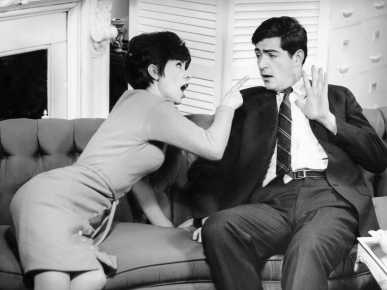 trying to concentrate on what her customer was asking her, turned to face the other way taking the card with her. Monica, now embarrassed as people had begun to watch the two, walked around to the front of the desk and once again gestured at Janice, but Janice promptly waved a dismissive hand in Monica’s direction. Before she knew it, Monica had reached out so quickly that Janice thought she was going to hit her, but instead she put her middle finger up directly in front of Janice’s face. Janice screamed out loud and all fell silent, including the customer on the other end of the phone. Monica, putting her head up in the air, walked back to her desk and began typing as if nothing had happened.
The names have been changed (to protect me) but everything else happened as described. I had worked in a team with these two for just under a year before this incident and in that time I never saw any appreciation between them one for the other. There was however varying levels of friction spinning around them at all times, and the ever present undercurrent always made meetings and social events a bit fraught. The moment Jack appeared back in the office both approached him, loudly complaining about one another in one big cacophony of noise. He took charge and said he would speak to them both privately and individually. In the middle of this scene the cake arrived and around 20 people flooded into their small office looking to attend a presentation.
What happened in the following days and weeks was, well, anything but helpful! The manager delayed speaking to the two individuals, instead approaching the HR department for help and advice as both parties had initially said that they were looking to raise a grievance against one another. The toing and froing between the HR department, the manager and the team members bimbled on, in the meantime each girl, talking to anyone who would listen, tried to rally support for their cause. As the story was told and retold each was re-framing the situation to portray themselves as the reasonable one trying to cope with the unreasonable behaviour of the other “you know what she’s like” etc etc. The tension in the office was palpable.
So what actions could have been taken in trying to build a lasting solution for these two individuals and the team as a whole?
In mediation we follow a methodology that aims to ensure constructive dialogue is established, this is to ensure that people can eventually reach workable solutions. This can never be achieved however when there’s heat in the situation, and so the first step is the cooling off phase. When involved in conflict of any sort, the primitive brain gets engaged to protect the self. It’s mental and physical fight or flight responses, leaves a person unable to reason at higher levels and so it’s important that nothing of meaning is allowed to be discussed while they are in this state of mind. Do whatever is necessary to provide individuals with space for cooling off and to re-engage their thinking brain. Have you ever crossed words with someone and the next day in the shower replayed the situation and thought “damn it! When they said that I should have said…..” Yes? Well that’s your thinking brain saying “had I been in charge yesterday I think you’ll find I had a pretty witty response.”
It is in the cooling off phase though that people become reflective and think about how their actions and words were perceived and if they are comfortable in how they represented themselves. It is at this point people seek to re-frame anything that they believe portrayed them in a bad light and so it’s important that they do this without seeking confederates to back their revised version of events. This is especially important if a HR process such as grievance does indeed need to be evoked, immediately or at a later stage, especially if witnesses are to remain objective and impartial. So from the onset individuals should be asked to remain professional and not to discuss the incident with their wider colleagues.
When enough time has passed to cool off but not enough for them to create a new paradigm, each should then have been given the chance to explain how things were from their perspectives. Managers, like Mediators, should take pains to emphasise that they are not there to pass judgement on what is right or wrong, rather are just looking to understand the dynamics of the relationship and hear about the situation from each of their perspectives.
A mediator should then be engaged to work with them both, leaving the manager and company in a supportive role for both parties. At these meetings the relationship between the parties should be explored thoroughly in order to determine if this was a ‘one off’ incident or a symptom of an ongoing issue.
Once both had spoken to the mediator they should then be invited to take part in a joint  discussion where the mediator would use their skills to ensure that each sought to both understand each other and to be understood. The mediator throughout this meeting should be framing the output in order to make the dialogue more constructive. For example, “she’s an interfering busybody” might come back as “I hear you say that XX is often too interested in other people’s work for your liking.” The end goal here is for the parties to both come up with a strategy for handling future misunderstandings that they have both signed up to. They should also be looking for actions to tackling core issues and here they may need company or leadership support. In the end each should be clear that going forward that type of free exchange of frustrations would not be an acceptable way to address an issue. It is important to note that a mediation meeting should be voluntary to take part in, would be looked upon favourably by the organisation and that taking part in mediation would not preclude them from taking any further actions should they wish. Knowing that it is on their terms and that it doesn’t close off any other avenues of redress, individuals are more likely to come to the table in the first place and then it is the skill of your chosen mediator that will ensure that the meetings are constructive and curative.
In my years of mediating, I have found that there are usually deeper rooted issues driving the dysfunctional behaviours of individuals and teams. A flash point is just that, a place where the tension surfaced and then bubbled over. Poor attempts at in-house mediation often concentrates on the issue that brought everything to a head, treating the symptom and not the disease so to speak and therefore not getting to the heart of the matter. It’s important to pull the thorn from the Lion’s paw no matter how hard it roars or you will either have a recurrence at some point or worse still drive the behaviours into more divisive passive aggressive type realms.
Follow me on Twitter: @NakedTrainingCo
 lexfarndell.com