Moving over when you are at the top is an emotionally charged situation no matter how it came around. I remember when Bush stood on the steps of the Whitehouse to greet Clinton for the first time, he stood steadfast at the top of the steps and let Clinton walk all the way up to receive his welcome greeting. His feelings on the whole matter were there present in that one gesture. I am completely fascinated by all of the relationships and complex alliances that I find when I am working anywhere within the Leadership arena. Some have politics that would rival that of a Tudor monarchs court or the goings on during Renaissance Italy.
A situation that I was recently involved in was that of a power struggle between the two top guys. There were also another two key players, whom, while seemingly uninvolved, were quietly working towards their own positional agendas. The top guy was older and getting close to retirement. He was slowing down and the young guy, earmarked to replace him, was quick minded and had youthful energy on his side.
When the young guy had first come along, the older guy was very kind to him, spent time with him and showed him the ropes. As the young guy matured in his role, the older guy started to feel threatened and his attitude towards him altered. He began to be short-tempered around the team and would snap at everyone for no apparent reason but especially at the young guy.
The situation worsened when the Big Boss began to deal more with the younger guy than with the older one, feeling it would be good for the older chap to slow down a little and the younger chap to widen his operational experience. Eventually emboldened by his time close to the seat of power, the young chap was ready for him the next time the older guy snapped at him. He didn’t back down and stood up for himself, finally showing his teeth. The two other key players, seeing the older guy vulnerable so to speak, got involved too in a variety of unhelpful ways. The result of this meant that the older guy just stopped engaging with any of them where possible, and would avoid any situations rather than face any potential conflict or further loss of face.
The above is actually a scenario of the ‘dog politics’ which were at play in our pack of working dogs at home. When him indoors and I were discussing the planning and management of the situation, it brought to mind a very similar political game being played out between a management pairing in an operational area.
In the working scenario, the old guy was actually a woman, and the younger guy was someone that she herself had put forward for leadership development following a talent management exercise. As he began to succeed and progress in his role and the better he did, the more her security was threatened, and from there on in the situation was tainted. He was often set up to fail and openly ridiculed and put on the spot for not pre-empting her needs. Because he still viewed her as his sponsor and mentor, along with the fact that in the company of her peers and leaders she complimented him, his confusion over the matter was great, and he was on edge the whole time.
Often when a company plans their talent management exercises, they put an extraordinary amount of effort into ensuring that they select the right candidates, provide the right development activities along with the right development opportunities, but pay little attention to the relationship between the induvial and the person that they are earmarked to succeed.
In our house, we get what this type of team working means in the succession planning of our working dogs, and I think we are good at managing it too. We set the standard for their behaviours, training, and professional development, and this throughout all of the various stages from puppy through to retired elder. Packs are all about strong leadership, focus and harmony and having a deep understanding of the ever-present ‘dog politics.’ We know it is not just the behaviour of the individual dog that matters but rather how they work together. We work to foster harmony between them ensuring that they see the value of working together. We give them shared activities and reward the pack for succeeding. We intervene when things are looking fraught and remember to give each their space and value. In fact, pack relationships could teach us a lot about leadership, but not all of the development activities used with packs of dogs would transfer smoothly to the boardroom; such as tummy tickling and treats.
Here endeth the analogy. Please only read on if you are interested in dogs with jobs. My dogs in particular.
Dog number one is an 11-year-old German Shepherd called Sowen. He had a long and successful career of sniffing out the really bad guys, and keeping them where they were until his Dad (yes dog handlers are called Mum and Dad) came to collect them. As many German Shepherds do, he got bad hips and so retired when he was 6 1/2. He was then self-appointed companion to my mum and so got to stay in the house. His job is now that of a second louder doorbell, and bouncer for canvassers and sales folk and is very successful at both. I don’t know if you have ever tried concentrating on delivering a doorstep pitch when a dog the size of a small pony is growling at you? Well, they don’t often make it to the end that’s for sure. Some are persistent, though, but they are easily taken care of by use of a barely whispered command to ‘speak’ he will start a volley of barking that drowns out any last ditch attempts. Believe me; everyone’s relieved when you make your apologies and close the door.
Dog number two is another ‘Land Shark’ called Slaine (named after Slaine MacRoth from 2000AD). Slaine is a scary dude. He has a jet black face out of which only his eyes shine, and this does make him look menacing. A highly trained K9 PC, he can, at speed: find, hold, and if necessary physically detain, anyone he was pointed towards. He can also find missing and vulnerable people of all ages, recover stolen property or find evidence that secures prosecutions.
Slaine is also a loving pack member that cares for our littlest dogs when they come along, teaching them with care and wisdom and the odd nip on the bum, how to fit into this particular pack.
Slaine at work and at play
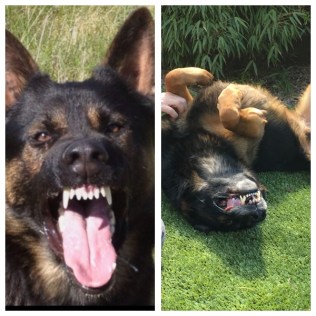
Interestingly a Shepherd does not follow the scent of a specific individual, so there is no point offering them someone’s shoe to sniff, and it’s amazing how many people do that. When they say to him indoors, “does he want this?” he’d love to say “only if you’ve got another three the same in a smaller size.” The dog follows a channel of scent in the air, which is a mix of human scent both chemical and natural dropping down and the rising scent of crushed vegetation, etc. They follow this trail with their nose to the ground and up in the air in order to find their quarry. It is amazing to watch, and I have also been that quarry. Even though you know the score, it makes your heart race on a primitive level to be hiding and be searched for. You hear them sniff for you before you see them!. The problem lies in the fact that, unlike a Blood Hound, the Shepherds don’t follow an individual scent pattern per se, they are looking for and following any fresh scent patterns. To keep the crime scene uncontaminated, officers cordon off the areas when they send for the dog, and don’t walk across the scene or into the areas because they don’t wish to contaminate it.
Dog number tree is a Spaniel called Merlin. He is made of love and cheek in equal measures but is an absolute expert at what he does. He is white with ginger ears, and his grin is so wide and joyful that he shows you his teeth. Merlin is one of the ‘little dogs’ as they are known and these dogs have specialist skills. They look for a specific category of scents and stick to one discipline only e.g. drugs, explosives, cash, firearms and even victim recovery. They train in their specialism starting from between the ages of one to two years. It varies according to the dog. Breeds like spaniels can have maturity issues at a year old but settle well with a few additional months. They train side by side and it is the dog and the handler that are licenced together as a pair. The little dogs can work for much longer than the big dogs because they don’t have as much physical exertion in their life.
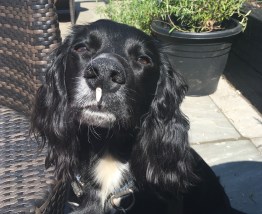
Dog number four is Thorin. Another ‘little dog’ and he is the youngest of the pack at just a year old. I am afraid that he is a wee bit ‘common’ looking and every other black spaniel I see looks just like him. Too young yet to work, his job right now is to simply learn to be; good with people, be comfortable in approaching folk, be obedient with good manners, keep his beautiful nature and quirky character and of course to make us laugh.
Thorin gave up looking for the petal he’d been chasing
 lexfarndell.com